
Cryptic Hermaphroditic Flowering in Male Plants of Dioecious Portulacaria pygmaea (Didiereaceae): Evidencefrom Rapid Fruit Development and Pollen Fertility
Author: TAKUYA KAGAWA
Affiliation: Independent Researcher (Succulent Saika, Japan)
ORCID:https://orcid.org/0009-0008-5006-3292
DOI:https://doi.org/10.5281/zenodo.17579964
Abstract
Portulacaria pygmaea (Pillans) Bruyns & Klak (formerly Ceraria pygmaea) is a dioecious succulent endemic to the arid regions of South Africa and Namibia. Here, I report three independent observations of fruit development on morphologically male plants cultivated under outdoor conditions in Japan during the summer of 2025. Male identity was confirmed through the presence of functional staminate flowers with anthers producing viable pollen. Despite the male phenotype, fruits developed on the same individuals, suggesting the transient expression of functional female organs. In a controlled pollination experiment, pollen from a fruiting male plant successfully fertilized flowers of a confirmed female plant, demonstrating functional male fertility. Seeds formed within fruits on male plants showed visible embryo development, although germination success was not achieved under the tested conditions. However, naturally shed seeds from a second observation showed germination, suggesting that seed maturity timing may be critical. These observations suggest cryptic hermaphroditism or environmentally-induced activation of female organs in male plants of P. pygmaea. This phenomenon parallels the gynodioecious reproductive system reported in Ceraria kaokoensis (Swanepoel, 2007) and may represent evolutionary flexibility in sex expression within Portulacarioideae. The rapid fruit development observed (complete maturation within 24–48 hours) and the occurrence in young (1–2 year old) seedling plants suggest that resource availability and ontogenetic stage may trigger this expression. Further histological and molecular analyses are needed to elucidate the developmental mechanisms underlying this sexual plasticity.
Keywords: Portulacaria pygmaea, dioecy, cryptic hermaphroditism, sex expression
plasticity, gynodioecy, Didiereaceae
1. Introduction
1.1 Dioecy and Sex Expression Plasticity in Angiosperms
Dioecy, the presence of separate male and female individuals, occurs in only 5–6% of angiosperm species and is considered an evolutionarily derived condition from hermaphroditism. The evolution and maintenance of dioecy involve complex genetic and environmental factors, and transitions between sexual systems have been documented in various plant families.
In some lineages, sexual systems exhibit plasticity, with individuals capable of expressing both male and female functions under certain conditions—a phenomenon known as cryptic hermaphroditism or functional lability in sex expression.
1.2 Taxonomic Position of Portulacaria pygmaea
Portulacaria pygmaea was originally described by Pillans (1928) based on material collected near Grootderm along the Orange River in Richtersveld, South Africa. The species was initially placed in the genus Portulacaria, then transferred to Ceraria by Rowley (1996) based on morphological considerations. However, molecular phylogenetic analyses by Bruyns and Klak (2014) demonstrated that the genera Ceraria and Portulacaria were not monophyletic as traditionally circumscribed. To resolve this polyphyly, all five species of Ceraria were transferred to Portulacaria, and the species is now correctly known as Portulacaria pygmaea. The genus is currently placed in the subfamily Portulacarioideae of the family Didiereaceae.
P. pygmaea is a dwarf, caudex-forming succulent endemic to extremely arid regions spanning the border between South Africa and Namibia. The species is characterized by water storage in both a tuberous caudex and succulent leaves, adaptations to environments where temperatures can reach 47°C. The species is listed as Endangered on the South African Red List due to habitat loss from diamond mining and collection pressure for the ornamental plant trade.
1.3 Sexual System in Portulacarioideae
Portulacaria pygmaea has been consistently described as dioecious, with distinct male and female individuals. Male flowers are typically greenish-white, while female flowers are smaller and pale pink to purplish. According to the original description, female flowers have a calyx of 0.75 mm, petals of 2 mm, a trigonous ovary of 0.5 mm, a style of 0.25 mm, and a minutely papillate stigma.
Importantly, sexual systems within Portulacarioideae are not uniformly dioecious. Swanepoel (2007) reported that Ceraria kaokoensis exhibits gynodioecy, with populations consisting of female individuals and hermaphroditic individuals bearing bisexual flowers capable of producing functional seeds. This finding suggested that sex expression within the former Ceraria clade is evolutionarily labile and that the potential for hermaphroditic function may be retained even in species currently classified as dioecious.
1.4 Objectives of This Study
The present study documents and analyzes three independent observations of fruit development on male plants of P. pygmaea cultivated in Japan. The objectives are to:
- Provide photographic documentation of the phenomenon
- Test the pollen fertility of fruiting male plants through controlled pollination
- Assess seed viability through germination experiments
- Discuss potential mechanisms and evolutionary implications of this observation
This report serves to establish priority for the observation and provides a foundation for more detailed morphological and molecular investigations planned for 2026.
2. Materials and Methods
2.1 Plant Material
All plants were seedlings grown by the author from seeds collected from cultivated plants of
Portulacaria pygmaea. Three individual plants are central to this study:
- Individual 1 (Observation 1): Seedling from 2024, approximately 1 year old at the
time of observation (July 2025). Sex was initially uncertain, later confirmed as male
through flowering. - Individual 2 (Observation 2): Seedling from 2024, approximately 1 year old at the
time of observation (July–August 2025). Identified as male through flowering during
the observation period. - Individual 3 (Observation 3): Seedling from 2023, approximately 2 years old at the
time of observation (August 2025). Previously confirmed as male in 2024 based on
flowering phenotype.
All plants were grown outdoors in pots under natural rainfall conditions in Hyogo Prefecture,
Japan. The summer of 2025 was characterized by record high temperatures and extended
heat waves, which may have influenced plant physiology.
2.2 Observational Timeline
Observation 1 (mid-July 2025):
A single fruit was discovered on Individual 1 in the absence of any nearby flowering plants. No photographs were taken at this stage as the observation was unexpected and initially attributed to possible labeling error. Subsequent flowering confirmed the plant as male, raising questions about the origin of the fruit.
Observation 2 (July 30 – August 11, 2025):
- July 30: A single developing fruit was observed on Individual 2, a young plant with
minimal flowering history. - August 6: The same plant produced staminate flowers with visible anthers and
pollen. This was the first definitive documentation (with photographs) of a male plant
simultaneously bearing fruit and male flowers. - August 6: A controlled pollination experiment was initiated using pollen from this
plant. - August 11: Successful fruit development was confirmed on the pollinated female
plant, demonstrating pollen viability.
Observation 3 (August 27, 2025):
Individual 3, previously confirmed as male in 2024, was observed with three mature fruits
while simultaneously producing multiple male flowers. This was the most robust observation,
with clear photographic evidence of both reproductive structures on the same plant.
2.3 Pollen Fertility Test
To test whether pollen from a fruiting male plant retained functional male fertility, a controlled hand-pollination experiment was conducted on August 6, 2025.
Pollen donor: Individual 2 (fruiting male plant)
Pollen recipient: A pure female plant, grown from seed for approximately 2 years in a 9 cm pot, with confirmed female identity based on consistent production of pistillate flowers in previous flowering seasons.
Pollen was transferred manually from freshly opened male flowers of Individual 2 to receptive stigmas of the female plant. The pollinated flowers were monitored daily. By August 11 (5 days post-pollination), clear ovary swelling and fruit development were observed, confirming successful fertilization.
2.4 Seed Collection and Germination Test
Observation 3 seed collection:
On August 28, 2025, fruits from Individual 3 were collected. A total of four seeds were
extracted. Macroscopic examination revealed that embryos were visible through the
semi-transparent seed coat, suggesting structural completeness.
Germination protocol:
Seeds were placed on moist tissue paper in a sealed plastic container to maintain humidity.
Based on prior experience with P. pygmaea seeds, germination typically occurs within 24–72
hours of imbibition under normal conditions. Seeds were sown on the following schedule:
- Seed 1: August 28, 2025
- Seed 2: August 31, 2025
- Seeds 3 & 4: September 3, 2025
Results
As of November 2, 2025 (66–75 days post-sowing), none of the four seeds had germinated.
The seeds remained intact but showed no signs of radicle emergence.
Supplementary observation:
In September 2025, a naturally shed seed from Individual 2 (Observation 2) fell onto a neighboring pot containing Agave utahensis var. nevadensis and subsequently germinated under natural outdoor conditions. This seedling was initially observed and documented but was later lost due to prolonged wet weather conditions in early November. This observation suggests that seed maturity and dispersal timing may be critical for germination success, and that early collection may have prevented full physiological maturation of seeds in Observation 3.
2.5 Photographic Documentation
Photographs were taken using a smartphone camera with macro lens attachment. Images
were dated and archived. Three key images are presented in this report:
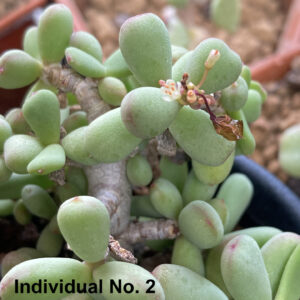
Figure 1. Coexistence of staminate flowers and developing fruit on Individual 2 of Portulacaria pygmaea (August 6, 2025). The male plant shows both functional anthers (white structures) and a mature fruit (green, enlarged ovary), providing the first photographic documentation of this phenomenon.
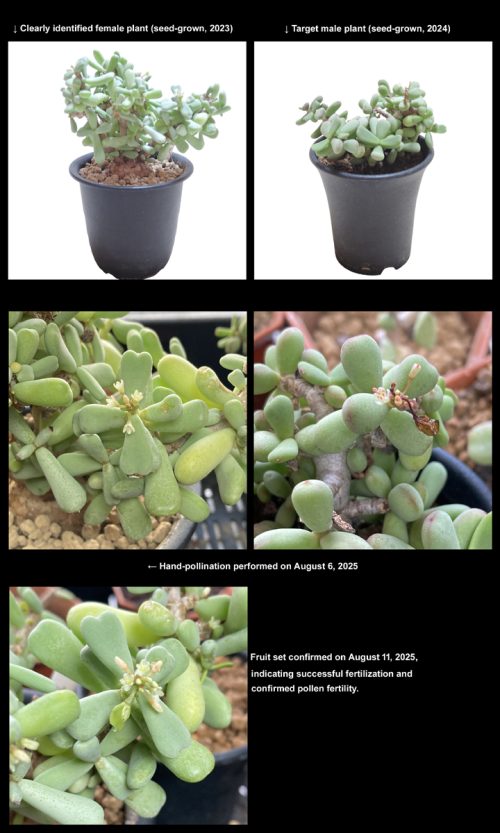
Figure 2. Pollen fertility test demonstrating functional male fertility in a fruiting male plant. Upper left: Pure female plant (seed-grown, 2023). Upper right: Target male plant with fruit (Individual 2, seed-grown, 2024). Hand-pollination was performed on August 6, 2025. Lower: Successful fruit development confirmed on August 11, 2025 (5 days post-pollination), indicating pollen viability and fertilization capacity.
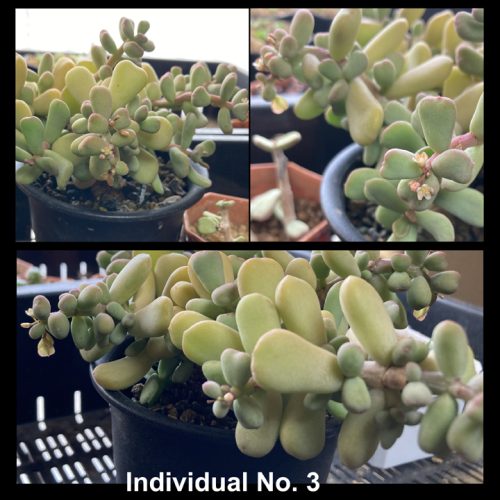
Figure 3. Multiple fruits (three) and staminate flowers coexisting on Individual 3 (August 27, 2025). This 2-year-old male plant, previously confirmed as male in 2024, demonstrates the reproducibility of the phenomenon across different individuals and years.
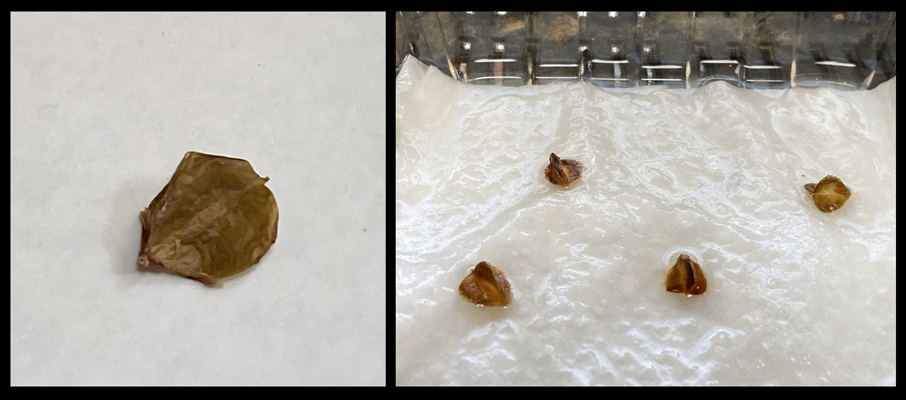
Figure 4. Seeds extracted from fruits of Individual 3 (August 28, 2025). Left: Magnified view showing visible embryo through semi-transparent seed coat. Right: Seeds placed on moist tissue paper for germination test. Four seeds were collected; none germinated under laboratory conditions by November 2, 2025.
3. Results
3.1 Observation 1: Initial Discovery
The first observation of fruit on a male plant occurred in mid-July 2025 but was not initially documented photographically due to the unexpected nature of the finding. The plant was young (1-year seedling) and labeled as male based on initial assessment. A single fruit was found in the absence of any nearby flowering individuals, raising the question of self-fertilization or retention of female function. Subsequent flowering in late July confirmed the plant’s male identity through the production of staminate flowers with functional anthers.
3.2 Observation 2: Pollen Fertility Confirmation
July 30, 2025: Individual 2 was found with a single developing fruit. The plant showed
minimal prior flowering history, and no flowers were present at the time of discovery. The fruit
was small and appeared to have formed rapidly.
August 6, 2025:The same plant produced several staminate (male) flowers with clearly visible anthers and pollen (Figure 1). The coexistence of fruit and male flowers on the same individual provided the first photographic evidence of the phenomenon. Remnants of previous flower pedicels were observed upon closer inspection, suggesting that the fruiting flower may have opened briefly and been overlooked during daily watering.
Pollen fertility test: Pollen from Individual 2 was used to hand-pollinate flowers of a confirmed female plant. By August 11, 2025 (5 days post-pollination), clear ovary enlargement and fruit development were confirmed (Figure 2), demonstrating that the pollen from the fruiting male plant was fully functional and capable of fertilizing a normal female plant.
August 27, 2025: Individual 3, a 2-year-old seedling previously confirmed as male in 2024, was found bearing three well-developed fruits while simultaneously producing multiple staminate flowers. This observation provided the most robust evidence of the phenomenon, as multiple fruits were present rather than a single aberrant case (Figure 3).
The fruits were mature and contained seeds with visible embryos. The plant had been under daily observation for watering, yet the transition from flowering to fruit maturation appeared to occur within a very short timeframe (estimated 24–48 hours based on the lack of intermediate stages observed during daily checks). This rapid development is atypical for most fruiting processes and suggests either cryptic (brief, nocturnal, or early morning) flowering or an accelerated developmental pathway.
3.4 Seed Morphology and Germination
Seeds extracted from the fruits of Individual 3 appeared morphologically normal, with visible embryos observable through the seed coat (Figure 4). However, none of the four seeds germinated under the tested conditions (moist tissue paper method), even after more than two months.
In contrast, a naturally shed seed from Individual 2 (Observation 2) germinated successfully under outdoor conditions when it fell onto an adjacent pot in September 2025. This suggests that:
- Seeds from fruiting male plants are capable of germination
- Early harvest (August 28) may have prevented full physiological maturity
- Natural seed dispersal timing may be important for germination success
5. Conclusions
This report documents three independent observations of fruit development on male plants
of Portulacaria pygmaea under cultivation in Japan. The phenomenon is characterized by:
- Coexistence of male flowers and fruits on the same individual
- Functional male fertility (demonstrated through controlled pollination)
- Production of seeds with visible embryos
- Germination capacity (confirmed for naturally dispersed seeds)
- Apparent rapid fruit development (24–48 hours)
- Occurrence in young (1–2 year old) seedlings
These findings provide strong evidence for cryptic hermaphroditism or facultative expression of female organs in male plants. This sexual plasticity is consistent with the gynodioecious system reported in Ceraria kaokoensis (Swanepoel, 2007) and suggests evolutionary lability in sex determination within Portulacarioideae. Environmental factors, particularly resource availability in cultivation, are hypothesized to trigger this expression by releasing developmental suppression of female organs that are normally non-functional in male plants.
This report establishes priority for the observation and provides a foundation for detailed morphological, histological, and molecular investigations. Further research will elucidate the developmental mechanisms and evolutionary significance of sexual plasticity in this endangered species.
4. Discussion
4.1 Cryptic Hermaphroditism in a Dioecious Species
The observations reported here provide compelling evidence that male plants of Portulacaria pygmaea can develop functional female organs under certain conditions, resulting in fruit and seed production. This phenomenon is most parsimoniously explained as cryptic hermaphroditism—the transient or conditional expression of both male and female reproductive functions in individuals of a dioecious species.
Three lines of evidence support functional hermaphroditism rather than parthenocarpy or other non-sexual fruit formation:
- Pollen fertility: Pollen from fruiting male plants successfully fertilized female plants,
demonstrating retention of full male function - Seed formation: Seeds contained visible embryos, indicating sexual reproduction
rather than pseudogamous fruit development - Germination capacity: Naturally dispersed seeds germinated, confirming
reproductive viability
4.2 Comparison with Ceraria kaokoensis and Sexual System Evolution
The discovery of cryptic hermaphroditism in P. pygmaea is consistent with the sexual system diversity already documented within Portulacarioideae. Swanepoel (2007) reported that Ceraria kaokoensis exhibits gynodioecy, with populations consisting of female individuals and hermaphroditic individuals that bear bisexual flowers capable of producing functional seeds. The authors noted that this finding necessitated re-evaluation of sexual systems in other species formerly placed in Ceraria.
The present observations suggest that P. pygmaea, while predominantly dioecious, retains the genetic potential for hermaphroditic expression. This may represent:
- Incomplete fixation of dioecy: The species may be in a transitional evolutionary
state between hermaphroditism and strict dioecy - Facultative hermaphroditism: Environmental conditions (resource availability,
stress) may trigger expression of latent female developmental pathways in male
plants - Ontogenetic lability: Young plants may exhibit less stable sex expression compared
to mature individuals
All three observations occurred in young seedlings (1–2 years old), suggesting that sexual
expression may stabilize with maturity.
4.3 Mechanisms of Sex Expression Plasticity
The transient nature of female organ development in male plants raises questions about the developmental mechanisms involved. In dioecious plants, sex-specific flowers typically result from suppression of the opposite-sex organs through programmed cell death (PCD) or hormonal inhibition.
Two scenarios could explain the observed fruiting in male plants:
Scenario 1: Incomplete suppression of female organs
Male flowers of P. pygmaea may contain rudimentary pistils (pistillodes) that are normally non-functional. Under conditions of high resource availability (cultivation with regular watering and nutrient-rich soil), the suppression mechanisms (likely involving PCD or hormonal signals) may be transiently bypassed, allowing pistil development to proceed to functional maturity.
This interpretation is supported by comparative morphology: in the related Portulacaria namaquensis, male flowers have a trigonous ovary but completely lack a stigma, representing stronger structural suppression. In contrast, if P. pygmaea male flowers retain even vestigial stigmatic tissue, functional activation may be more readily achieved.
Scenario 2: Cryptic bisexual flowers
The flowers that developed into fruits may have been transiently hermaphroditic, possessing both functional anthers and functional pistils. The apparent rapid fruit development and lack of observed flowers during daily monitoring suggest that such flowers may have opened very briefly (hours) or during nighttime/early morning, escaping observation. Flower remnants were observed in Observation 2, consistent with brief flowering followed by rapid fruit maturation.
4.4 Environmental and Physiological Triggers
Portulacaria pygmaea is native to one of the most extreme arid environments in southern Africa, where resource limitation is severe. Under such conditions, dioecious reproduction with sex specialization is advantageous, as female plants can allocate resources exclusively to costly fruit and seed production, while male plants invest only in pollen.
In cultivation, however, regular watering and nutrient availability remove these constraints. The release from resource limitation may allow male plants to reallocate resources to female functions that would be suppressed in natural habitats. This interpretation is consistent with resource allocation theory in plant reproduction, which predicts that sex expression can shift in response to resource availability.
The rapid fruit development observed (complete maturation within 24–48 hours based on observation intervals) is unusually fast and may indicate a developmental “shortcut” pathway when both sexes are expressed simultaneously, potentially involving accelerated hormonal signaling or pre-formed ovule structures that require only minimal resources to complete development.
4.5 Evolutionary Implications
The retention of hermaphroditic potential in P. pygmaea suggests that dioecy in this species
is not irreversibly fixed at the genetic level. This finding has several evolutionary implications:
- Evolutionary lability: The ease with which male plants can express female functions
suggests recent evolutionary origins of dioecy in this lineage or ongoing selection
maintaining flexibility - Reproductive assurance: In sparse populations or isolated individuals, the ability to
produce seeds on male plants could provide reproductive assurance, preventing
complete reproductive failure - Parallel with gynodioecy: The presence of gynodioecy in C. kaokoensis
(Swanepoel, 2007) and cryptic hermaphroditism in P. pygmaea suggests that
Portulacarioideae as a whole may be in a transitional evolutionary state regarding
sexual systems
4.6 Limitations and Future Research Directions
The observations reported here are preliminary and based on opportunistic discovery rather
than systematic experimental manipulation. Several key questions remain:
- Frequency of the phenomenon: Is cryptic hermaphroditism rare or common in
cultivated P. pygmaea? Systematic surveys of larger populations are needed. - Histological confirmation: Detailed anatomical studies are required to confirm the
presence of functional ovules, stigmatic papillae, and vascular connections in fruiting
flowers from male plants. - Flowering phenology: Continuous monitoring (time-lapse photography or multiple
daily observations) is needed to determine if hermaphroditic flowers have distinct
phenology compared to typical male flowers. - Genetic basis: Molecular identification of sex-determination genes and their
expression patterns could reveal whether cryptic hermaphroditism involves transient
changes in sex-determining pathways. - Self-compatibility: It remains unclear whether the fruiting male plants were
self-pollinated or cross-pollinated by nearby males. Controlled isolation experiments
could test for self-compatibility.
References
- Bruyns, P. V., & Klak, C. (2014). Phylogenetic relationships in the Didiereaceae with special reference to subfamily Portulacarioideae.Taxon, 63, 1053–1064.
https://doi.org/10.12705/635.36 - Li, A. M., Luo, Y. B., Ge, S., & Zhang, D. Y. (2010). Cryptic dioecy in Mussaenda pubescens (Rubiaceae): A species with stigma-height dimorphism.Annals of Botany, 106, 521–531.
https://doi.org/10.1093/aob/mcq146 - Pillans, N. S. (1928). Portulacaria pygmaea.Bothalia, 3, 158.
- Rowley, G. D. (1996). Taxonomic innovations for the IOS Lexicon.
Bradleya, 14, 105–107.
https://doi.org/10.25223/brad.n14.1996.a10 - SANBI (South African National Biodiversity Institute). (2006). Red List of South African Plants.
https://redlist.sanbi.org/species.php?species=3972-4 (Accessed November 2025) - Swanepoel, W. (2007). Didiereaceae/Portulacaceae. Ceraria kaokoensis, a new species from Namibia, with notes on gynodioecy in the genus.Bothalia, 37, 202–206.
- Venter, H. M., Bester, S. P., & Verhoef, M. (1993). A preliminary study of sexual reproduction in Portulacaria afra. African Journal of Range & Forage Science, 10, 53–58.
https://doi.org/10.1080/10220119.1993.9638323